Filling the Gap with New Information

Last year we started looking at sense-making activities for the presentation phase of a lesson. Our first post introduced the idea; our second listed types of sense-making activities with brief examples. Now, we’re making our way through each type with more detailed examples and potential usage guidelines.
Earlier in the summer, we looked at games for sense-making and then objective exercises. The focus of this post is on information gap activities. As you read through the examples and guidelines below. Keep in mind:
Our Definition of Sense-Making Activities: Here on Master Teaching, we’re defining sense-making activities NOT as practice exercises or tasks that follow up on the presentation of new material. Rather, they are presentation phase activities that guide students to make sense of new information before or in place of a lecture or explanation given by the teacher or textbook.
Your Participation: We’d love to hear from you about your sense-making activities. If you’d like to submit an activity or report on one you’ve used, you can post a comment below or communicate with us privately through our contact us page.
Now, let’s talk about using information gap for sense-making during the presentation phase of a lesson.
Definition
Information gap is a pair or group activity where members have access to different sets of new content (from their background knowledge or given by the teacher) that are combined in order to make a whole. In other words, each pair/group member “fills the gap” of information for their group by sharing their set of new content. In effect, learners are teaching each other.
Guidelines
1. When using information gap as a sense-making activity, the focus is on new content rather than knowledge learned previously.
2. Each member of a pair/group has access to different content. It may come from their background knowledge. Alternatively, new information may be provided by the teacher, and each member first learns their assigned set. Then, members take turns using what they already know or have learned to fill the gap for their pair/group.
3. Depending on the amount and type of new content, learners may need time to prepare before filling the gap with their pair/group. Preparation could be done as homework or in class in some circumstances (when time is not an issue, for example, or when students prepare in groups as part of the learning process).
4. While pairs/groups are preparing and then working in groups to fill the gap, they will likely need a specific task to complete–a set of questions to answer, a t-chart or diagram to fill out, a checklist to mark off, etc.
5. Close monitoring, feedback, and/or a follow up discussion are important in order to help learners come to particular conclusions and reach the learning goals of the activity.
Types
You’ve likely used information gap, including some of the types below, for practice activities. Have you also used them as sense-making activities? How? If not, consider how you could use each type to help learners figure out new material. The first two below work well for new content that is given by the teacher. The last two fit well when drawing on learners’ background knowledge.
1. Jigsaw/Expert Groups: New information is divided into parts (for example, four sets). Different groups are assigned a particular set and become “experts” in their set. Then, the teacher moves learners into new groups which include one expert in each set of information. Then, experts fill the gap for their new group by sharing what they learned in their first group.
2. Pair/Group Dictation: One member of a pair/group is designated the writer/artist. Other members consult a prompt (written or audio/visual) and fill the gap for the writer/artist who reproduces the prompt or fills in a diagram, chart, etc. Part way through the activity, if appropriate, group members may rotate roles. At the end, the group compares what they produce with the prompt.
3. Snowball: Learners individually process background knowledge about new content. Pairs share their background knowledge, learning from each other. Pairs form groups of four and continue sharing and learning from one another. The process continues as groups “snowball” from four to eight, from eight to sixteen, and more depending on the size of the class. The activity ends with a whole class discussion to check and continue their learning.
4. Interviews: Learners interview classmates in order to learn from their background knowledge about new content. Interviews could be done in pairs, rotating pairs, or groups as learners fill the gap for their classmates by drawing on what they already know or have experienced.
Examples
1. Jigsaw for Reading/Listening
Shoshannah Hernandez shares a template she uses to set up jigsaw activities for a longer reading or listening passage.
2. Bilingual Dictation
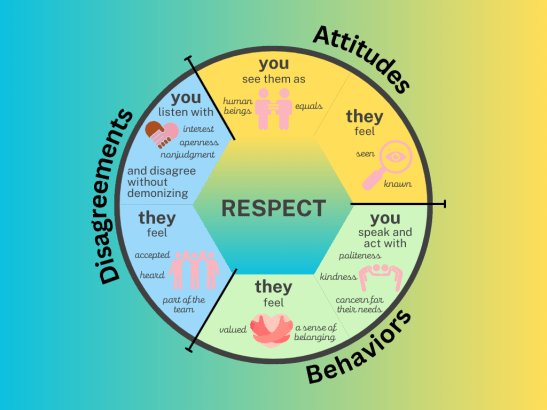
In China, I’ve given workshops to groups of primary school teachers that include Chinese/English speakers and Chinese only speakers. Once in a workshop on building respect, I paired up the bilingual teachers with the Chinese only individuals. On the screen, I projected a graphic I’d designed on Canva that gave a definition of respect relevant to their context. The bilingual teacher in each pair explained the graphic in Chinese to their partner so that s/he could create a Chinese version on paper. (They were encouraged to consult a dictionary for clarification of any terms in the graphic.) We then discussed how this definition of respect might be viewed in their society and fit into their school culture.
The link will take you to another of Shoshannah’s templates, this one for a running dictation, an information gap activity to help learners make sense of a passage.
4. Family Snowball
At the beginning of a unit on family in a speaking class, my first goal is for students to learn family relationship terms by drawing on one another’s background knowledge. I project my photo family tree on the screen. Individuals are given a list of family terms (categorized by relationship and generation) and begin to think of phrases or sentences using terms they already know to describe members of my family. (That is her dad. Her mom. She has three sisters.) Then, they pair up with another student, and speak phrases/sentences to describe my family. Each time they use a word on the list, they check it off. Pairs are put together to form groups of four and continue the process. Groups of four are combined to form groups of eight, and then if the class is large enough, we snowball to groups of sixteen and finally the whole class. At the end of the activity, I check learners’ comprehension of terms that are difficult for them and discuss any that they haven’t yet figured out.1
5. Grammar Use Interview
When we reach the usage section in a lesson on the passive voice, students look at some examples and identify reasons for its use. In the past, I’ve facilitated a pair followed by whole class discussion. Sometimes the discussion goes well; other times not (and I end up talking too much). The next time I teach this lesson, I’m going to try an interview. First, pairs will work together to identify reasons while filling out a t-chart. Then, students will rotate and interview a person from a different pair about their group’s ideas, filling in the next column on their chart. Then, after everyone returns to their original pair, they will compare what they learned from other pairs and make a list of their conclusions before our whole class follow up to check their ideas.
- You can find a published version of this activity in “Ways of Using Speaking to Teaching” in Teaching Speaking by Tasha Bleistein, Melissa K. Smith, and Marilyn Lewis, TESOL Press, 2020. ↩︎
Further exploration
Some online tools that were mentioned in this post:
- The placemat strategy (in Shoshannah’s first example)
- Canva
Try it out
We’re hoping to hear from you! What sense-making information gap activities have you used during the presentation phase of a lesson, and how? What types would you add to our list, or what examples could you share? You can respond in the comments below or in a private message through our Contact Us page.
Post Author
Image by Greg Plominski from Pixabay
One comment on “Filling the Gap with New Information”
Leave a comment

 Master Teaching
Pingback: Audio/Visual Sense-Making | Master Teaching