Making Sense with Objective Exercises
Last year we started looking at sense-making activities for the presentation phase of a lesson. Our first post introduced the idea; our second listed types of sense-making activities with brief examples. Now, we’re making our way through each type with more detailed examples and potential usage guidelines.
Our last post looked at games for sense-making, The focus of this post is on objective exercises. As you read through the examples and guidelines below. Keep in mind:
Our Definition of Sense-Making Activities: Here on Master Teaching, we’re defining sense-making activities NOT as practice exercises or tasks that follow up on the presentation of new material. Rather, they are presentation phase activities that guide students to make sense of new information before or in place of a lecture or explanation given by the teacher or textbook.
Your Participation: We’d love to hear from you about your sense-making activities. If you’d like to submit an activity or report on one you’ve used, you can post a comment below or communicate with us privately through our contact us page.
Now, let’s talk about using objective exercises as sense-making activities during the presentation phase of a lesson.
Definition
Objective exercises are closed-ended, short response exercises. They have clear right or wrong answers. As sense-making activities, they guide learners to figure out new terms or basic concepts. They also work well as a lead-in to other types of sense-making activities in order to build background knowledge or give learners a foundation of information before engaging in activities that require higher order thinking skills.
Guidelines
1. Objective exercises are set up so that terms or concepts are learned through the completion of the exercise. In other words, they are designed so that learners figure out new information rather than practicing previously learned materials.
2. In order to ensure that learners are processing new information adequately, a series of objective exercises, sometimes combined with other types of sense-making activities, may be needed. The series can be organized from easy to difficult and from lower order to mid or higher order thinking skills.
3. Objective exercises are often easy, but they should include enough of a challenge that learners feel a sense of accomplishment.
4. If the exercises are easy, learners will likely naturally do them individually even if you ask them to work in pairs. However, if the exercises include a challenging, problem-solving task, pair or group work is a better choice. Collaboration encourages students to negotiate with and learn from one another while building their cooperation skills.
5. Close monitoring, feedback, and/or a follow up discussion are important in order to help learners come to particular conclusions and reach the goals of the exercise(s).
Types
You’ve likely used some of the different types of objective exercises below as practice activities. Have you also used them as sense-making activities? How? If not, consider how you could use each type to help learners figure out new material.
1. Closed Questions: a series of short answer questions with clear right or wrong answers that break down a concept so that learners can figure it out step by step
2. Cloze: fill-in-the-blanks exercise, possibly with a word bank, that helps students figure out content
3. Describing or Defining: coming up with a viable definition or description of content using a set list of words or phrases
4. Matching: matching terms to definitions, concepts to descriptions, ideas to graphics, etc.
5. Multiple Choice: choosing definitions or descriptions from a list of choices
6. Sequencing: putting the steps in a process in order, lining concepts up by level
7. Sorting: sorting words, phrases, or ideas into categories as a means of understanding two or more concepts
8. True/False: deciding whether definitions, descriptions or explanations of terms/concepts are true or false
Examples
The Core Values Activities from our Games post included a matching game followed by a matching exercise so that learners could figure out the English translations of their society’s twelve core values.
2. Books of the Bible Objective Exercises
In order to build background knowledge, last week’s Books of the Bible Jeopardy could begin with a series of objective exercises in place of the warm up activities. The examples you see here include a true/false and multiple choice exercise:
3. Beginning Level ESL
In a beginning level ESL class in the U.S., students had been working on saying their home addresses. Rather than telling them occasions when they might be asked for their address, the teacher guided the students to match these to pictures (school, doctor, dentist, eye doctor, library, and a 911 call). Then, the teacher randomly matched occasions to pictures, and they responded “yes” or “no” (a true/false exercise). These exercises were repeated, first as a class, and then individually, until students had figured out all the vocabulary.
4. Future Teachers Program
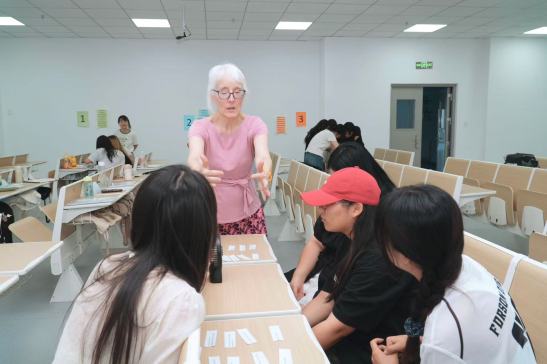
In a Future Teachers Program at my university in China, modeling what I’m teaching is vital. Over a series of workshops during students’ freshmen and sophomore years, I used a variety of sense-making activities including objective exercises to help learners figure out concepts rather than directly explaining or lecturing. When introducing transmission vs. constructivist approaches to teaching, learners first completed a series of objective exercises—multiple choice, matching, and closed questions—before moving on to other sense-making activities. For Bloom’s Taxonomy, they first sequenced the six categories and then matched descriptions, verbs, and finally products to each level. When they learned about Maslow’s Hierarchy of Needs, they matched levels to descriptions and sequenced them.
When planning our seventh workshop, my creativity ran out, and so instead of a sense-making activity, I prepared a brief lecture. While I was talking, the students’ facial expressions told a tale of boredom and dissatisfaction. When we reached the new materials part of our eighth workshop, I first apologized for my lecture in our previous meeting and then guided them through the Learning Activity Deconstruction exercises. As the cover photo reveals, I struggled to give good feedback during the sorting exercise. But they caught on and then smiled with the success (and fun) of having figured out concepts through their efforts rather than listening to my boring explanations.
Further exploration
Some online tools that could be used for objective exercises are listed here.
Try it out
We’re hoping to hear from you! What sense-making objective exercises have you used during the presentation phase of a lesson, and how? What types would you add to our list, or what examples could you share? You can respond in the comments below or in a private message through our Contact Us page.
Post Author
2 comments on “Making Sense with Objective Exercises”
Leave a comment

 Master Teaching
Pingback: Filling the Gap with New Information | Master Teaching
Pingback: Audio/Visual Sense-Making | Master Teaching