Sense-Making Activities

Many English language teachers are familiar with the 3 Ps approach to lesson planning. First, comes the PRESENTATION of some content (a grammar structure, set of vocabulary, or an aspect of culture, etc.). Then, the students are engaged in some PRACTICE activities that may range from manipulating the content to using it in controlled contexts. Finally, the teacher engages learners in a PRODUCTION activity or two where the content is used in authentic contexts and ways that imitate real world communication.
Often (though not always), the PRESENTATION PHASE comes in the form of a brief lecture, an explanation, or some learning materials. In other words, knowledge or content is given by the teacher and acquired by the students before they engage in practice. In this teacher-directed approach to the presentation phase, students first listen or watch (the teacher and a media presentation or a video, for example) or read (learning materials), and then they practice whether in class or at home.
I wonder how many teachers, like me, have reflected back on the presentation phase with questions like the ones below.
- How could I make sure the students really get it? Their performance during practice and production activities and also on homework suggests they’re still missing some important pieces.
- How could I get them to be more attentive and involved? Their facial expressions indicated that their minds were elsewhere.
- What would make learning more enjoyable for them and motivate them to learn more?
Over a couple of semesters, Teacher Fang* and I spent a great deal of time considering these questions. Her students’ level was a few steps below the assigned textbook. Many of them lacked confidence. Some appeared to have no desire to learn English. Teacher Fang expressed a goal to engage and motivate them, perhaps wanting to pass on her love of learning and English to them. As we discussed how to reach her goal, one conclusion we came to was a need for something other than long lectures which the students had neither the proficiency nor the motivation to take in. But we struggled to find a replacement that she felt comfortable managing. Letting go of teacher control posed a challenge for her.
One option we worked on was to set up SENSE-MAKING ACTIVITIES for the presentation phase.
When students encounter new ideas, information, or skills, they must have time to run this input through their own filters of meaning. As they try to analyze, apply, question, or solve a problem using the material, they have to make sense of it before it becomes “theirs.” This sense-making—or processing—is an essential component of instruction. Without it, students either lose the ideas or confuse them.
~Carol Tomlinson (1)
In Social Constructivist terms, sense-making activities during the presentation phase encourage learners to build their own understandings of new information by drawing on their background knowledge and negotiating with others who are also engaged in sense making.
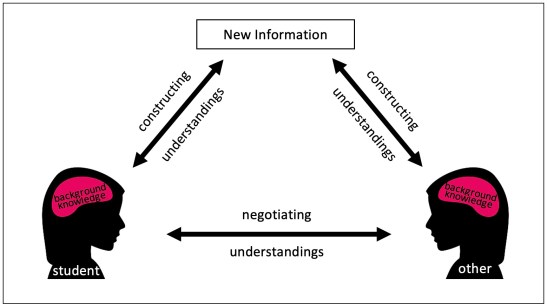
Using sense-making activities during the presentation phase had the potential to help Teacher Fang innovatively respond to some of the challenges she faced. Let’s consider sense-making activities from her, the teacher’s, and then the learners’ perspective. Remember, these are not practice activities that occur after the presentation phase but activities that replace direct instruction during the presentation.
For Teachers
Although teachers take a background role rather than providing direct instruction, they maintain a certain level of control. When asked for examples of sense-making activities, teachers and learners I interviewed used the word “guided” to describe their experiences. This guidance appears at every stage of a sense-making task.
- Design: Teachers design sense-making activities so that they guide learners toward specific goals and particular conclusions about content.
- Implementation: During sense-making activities, teachers monitor. They look over learners’ shoulders while they work and listen in on pair/group interactions, assessing when to hold back and when to intervene in order to clarify directions, offer encouragement, ask or answer a question, or redirect.
- Feedback: After a sense-making activity, teachers use guided discussions or provide specific feedback in order to ensure that learners reach goals by coming to particular conclusions. (In some cases, teachers may need to refine conclusions as they join the process of sense-making and learn from their students.)
- Follow up: Sense-making continues—and deepens—in the practice and production activities that follow. As learners progress beyond understanding and put knowledge to use, teachers continue to guide, though moving further into the background as learners become more capable and confident.
For Learners
How do sense-making activities for the presentation phase work from the learners’ perspective? How do they benefit learners? Instead of direct instruction here, how about engaging in a sense-making activity? Take a look at the graphic below. Then, using what you already know (from previous learning/teaching experiences or from reading the paragraphs above), try answering the three questions below the graphic.
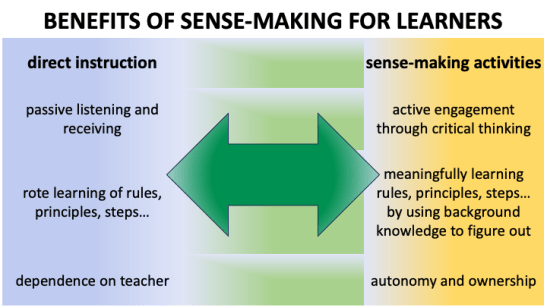
- How might learners describe a sense-making activity for the presentation phase?
- According to the graphic, what benefits do these activities have for them?
- What other benefits have you seen?
Over the next few months on Master Teaching, we’ll be looking at some different types of sense-making activities for the presentation phrase. We’ll give some examples and talk about how they work. Throughout, we are very interested in hearing from you as we try to curate a “database” of activities. Each week in the Try It Out section below, we’ll give you an opportunity to participate. You can respond by commenting. Or you can send us a private message through our Contact Us page.
* Name and some details changed in order to protect the privacy of both teacher and students.
Further exploration
- How to Differentiate Instruction in Academically Diverse Classrooms, 3rd Edition, chapter 13, by Carol Tomlinson.
- Teaching Speaking, chapter 5, “Ways of Using Speaking to Teach,” by Tasha Bleistein, Melissa K. Smith, and Marilyn Lewis.
Try it out
Based on this post and your teaching and learning experiences, reflect on some different types of sense-making activities for the presentation phase. If it would be helpful, you could first list some examples of sense-making activities you’ve experienced and then categorize them. In the comments below or in a private message through our Contact Us page, send us a list of types or categories you identified.
Post Author
Photo by Pixabay
4 comments on “Sense-Making Activities”
Leave a comment

 Master Teaching
Pingback: Games for Sense-Making | Master Teaching
Pingback: Making Sense with Objective Exercises | Master Teaching
Pingback: Filling the Gap with New Information | Master Teaching
Pingback: Audio/Visual Sense-Making | Master Teaching